Friday, 31 January 2014

F2...And So The CTPK Search Goes On

I have moved the F1 spawns of:

 
Black Orchid CT Male (above) x Black Marble HMPK Female (below)


And...
 
Marble Dragon HMPK Male -deceased (above)  x Turquoise DR CT Female (below)


...into bigger accommodations. To the naked eye, they all seem to be benefitting from the move and growing nicely. According to my measurements, not a whole lot has changed...we'll see.

Moving the two spawns left me with two spare spawn tanks. One, I'm leaving empty for now. It may come in handy as a separate growout for a few females, or as a hospital tank. The other I've decided to setup an F2 spawn from:


Marble HMPK Male - deceased (above) x Turquoise DR CT Female (below)


The brother x sister pairing looks like this:
 
 
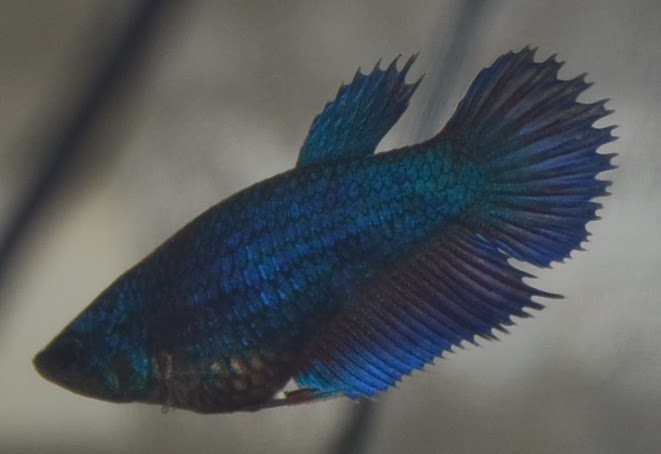
Turquoise (Metallic Green even...) Marble Combtail Male (above)


Royal Blue with Red wash (Marble Geno) Combtail Female (above)
 
They are only in the conditioning stage at the moment, being fed an increased diet of frozen blood worm. The male is taking claim to his new territory (which he's been in for the past three days). The female has been setup in a beanie box beside him. They are carded. They'll have their first view of each other just before bedtime tonight.
 
He has remarkable colouring with the dragon influence of Dad possibly adding to his metallic modifiers. The turquoise looks much more like a metallic green than anything I've seen in front of me before. He also has a good start to a dorsal, nice masking, single point ventrals, and nice top line. All his unpaired fins show the influence of mum's long fins.
 
She has an okay top line, a narrow-based dorsal, good masking, single point ventrals, an even anal and better webbing reduction all over than he does.
 
Hopes: As both carry impartial penetrant genes and the plakat genes of the father, and the DR CT long fin genes of the mother (who also had a nice dorsal), I'll be looking for plakats with better webbing reduction and who carry on the metallic green.


Wednesday, 22 January 2014

RIP Ghost

I'd decided a little while ago that I'd stop advertising the death of any of my fish. Betta reportedly live anywhere between 1-3 years on average, and there is a school of thought around that power growing Betta fry actually shortens Betta life span (anecdotal evidence only around for this, as far as I know).

Betta will, unfortunately, die in a relatively short time period. Have enough fish in your fish room, and it will seem like your turning over fish to the Reaper on a regular basis.

For all these reasons, Betta obituaries would become too regular for my liking, but for Ghost I will make an exception.


Ghost was sold to me by a lovely young lady based in Melbourne, who had kept him for a while and hadn't had any success in trying to breed him. She had got him from an importer. It was estimated that he was around 12 months old when he arrived in my Fishroom.

After investigation, and the seeking of advice from more experienced breeders than I, it was determined Ghost was a White Dragon Marble Halfmoon Plakat.

Ghost was placed in the spawn tank nearly every month I had him, without success. There was doubt cast upon his partners gender, doubt on my ability, and doubt over the environment and/or processes involved. It was a very frustrating time for him and for me...

Eventually, on the 13th of December 2013, Ghost was paired with Pippa in the attempt to start another CTPK line, and to expand the hunt for a better green line.


They spawned over 180 eggs! For the first month or so, there were lots of deaths and it was very disheartening, but things have stabilised now and there is 20-30 fry growing quite nicely now and awaiting their movement into bigger premises (scheduled to happen soon).


At five weeks, as you can see with the fella above, the iridescent layer is beginning to show. A sibling pairing from this spawn will not only advance the CTPK line, and possibly the hunt for green, but may just give me back some grandchildren who take after their grandad.

But Ghost's experiences with the spawn tank didn't end there.

I'd lined up a Yellow CT I really wanted him to spawn with - actually it was becoming an obsession. They had three attempts previous to me matching Ghost with Pippa. After his success, I thought it time to try him again. The Yellow CT had been named Jury (due to the debate over her gender, and the jury still being out). With meticulous care, I conditioned the pair up and put them together...


On the 3rd of January 2014, Jury's gender was definitively declared as female, as she and Ghost produced a nest of about 30-40 eggs.


At week two, all fry are very pale or white. Fingers crossed I have not only a second line of F1 CTPK from Ghost, but these little guys are carriers of the Cambodian, NR1, and Dragon genes. A sibling cross from these should give me CTPK versions of Ghost, and allow me to introduce the Cambodian and NR1 gene into all the CTPK lines moving forward.

Lastly, I'm also hoping to a get a lot of good F1 CTPK males from Ghost's efforts. With his passing, I currently have only one definite adult male (a long fin copper SD tail-biter) in my Fishroom. Still waiting on the final verdict for two possible male juvenile F1 CTPK from another line, but if they turn out to be girls (like their five sisters), then there will be a serious lack of testosterone in my tanks until these spawns grow up...

Friday, 10 January 2014

Never Stop Learning

Been busy since the last update.

My new male barracks has been a partial success, and a huge mistake. The mistake was by me, not the barracks. I set it up, and spent a week seeding it with nitrifying bacteria so the Nitrogen Cycle would be well established before putting in any fish.

So I filled it up, added SeaChem's Stability for a week, and then, on a whim, added the three boys. What I should have done, was tested the water - it would most probably would have shown no reading on the Nitrate scale, meaning it was cycled...because the chlorine and chloramine still in the water was killing any good bacteria from being able to establish itself.

Yes, I forgot to condition the water...stupid beyond all words on my behalf...and it cost me. Of the three males I put in there, two were SD I was hanging onto for no other reason than to provide nutrition for plants and allow me to maintain cycled tanks (ironic much?) The other was a prize Marble Dragon HMPK, Jason.


Jason, and one of the other males passed away from my stupidity. Chloramine poisoning. A horrible way to go, and something I didn't realise quickly enough to save them. It destroys gill tissue and effectively suffocates the poor fish. Because Betta have a labyrinth organ, these guys hung on a little longer than most, but still they succumbed after 24 hours. The general lack of appetite, and increasing lethargy alerted me to the fact something was wrong, but figuring out what it actually was, was too late to save these guys. The third fella is now doing well (except for suddenly deciding he wanted to eat his tail - yet another example of why I'm moving to plakats).

Lesson #1: Have a check list for setting up a tank, and don't take short cuts. Physically check off each step as you do it, and only as you do it. Your fish will thank you by not dying a horribly painful and slow death.

The barracks has now been correctly treated and seeded and contains the above mentioned tail-eater, Ghost (my other prized Marble Dragon HMPK), and the first jarred male fathered by... Jason.

 
Jason Jnr marbling from turquoise to ....
 
Jason Jnr (BJT20130924M1) will be paired up with his turquoise sister BJT20130924F1 (not using names for breeding stock anymore). Both are still maturing so this spawn is still a few months off.

Which is just as well, because the long sought answer to the mystery gender of my Yellow CT has finally been answered!


The bearded one with the longer than  normal fins is most definitely female. Yes, I finally got the spawn I was most after, above all others in the Fishroom. The above Yellow CT (also possibly a carrier of the Cambodian gene) was successfully spawned with Ghost, after three previously unsuccessful attempts. Normally, it's three strikes and you're out, but I can be stubborn to a fault when I really want something...

For two and a bit days, I watched Ghost like a hawk. If there was any evidence of snacking, he was coming out. On two occasions I almost removed him, but managed to calm myself and let him get on with it. I showed some trust because he'd already successfully hatched out one spawn. Sure enough, on the evening of day three, I had transparent tails hanging from the nest. I was over the moon! My trust had been well placed.


On the morning of the third day after their hatching, his nest was gone. Ghost was patrolling the tank. I couldn't see any fry anywhere. It took me about 0.249 seconds to release a pent up expletive. I couldn't believe it...all this time, and he decides to snack when I was expecting to see free swimmers. I took up my trusty magnifying visor (yes, I have a visor instead of a hand-held glass...I know, very geeky, but keeps my hands free) and searched around the tank. I couldn't see anything resembling a fry.

I was gutted, but not all was lost. Ghost was now twice as experienced, and the gender of the Yellow CT was confirmed, I'd just condition them up and go again. I reckon it took me a further 0.452 seconds to come to that conclusion, and another nanosecond to decide to get it started. As I'd already determined there was no fry, I figured the big siphon would get the job done of cleaning the spawn tank quicker for me. Out came Ghost...in went the siphon.

It is at this point I should mention I'd not yet had my morning shower. I was still somewhat sleepy, and my eyes aren't the best at focusing on small things, particularly small, transparent things...

Lesson #2: Never do anything with Betta in haste. Take a breath, think about it, seek advise if needed, and then act only if 100% sure.

I'd sucked up around a dozen fry into my 'dirty water' bucket before I'd figured it out. Plenty of expletives followed. I managed to rescue all the fry from the bucket (I hope), and get fresh water into the spawn tank. I've since done a couple of controlled siphons around the bottom of the tank and haven't yet sucked up any dead fry (touch wood). I seem to have been extremely lucky.

And today, I started researching the Big Ear/Dumbo Betta trait - not because I want to breed them, but because someone asked a question, and I was unsure of the answer. Seems the trait is recessive and another partial penetrance...that is, it doesn't always show up in the fry and will only be gotten back in F2, and preferably by breeding a sibling back to the ee parent. Crossing siblings increases the risk of asymmetry.

Lesson #3: The internet is the Betta breeders friend. Join an online forum (AusAqua is excellent), join a Facebook group (AusAqua has one of those as well). 

But above all, enjoy your fish :)

Wednesday, 1 January 2014

2014 Update

Finally got around to actually cleaning up the Fishroom. The new male barracks are in and currently three boys are getting used to their new accommodation. It needs some live plants but I'm still organising that.

 photo DSC_00452.jpg

I now have two empty grow out tanks. I need to get some more Bristle nose catfish so the plants will continue to be nourished by fish waste...need to work on that over the next couple of weeks.

 photo DSC_0047.jpg
 
The third growout only has four F1 CTPK left in it (along with the resident BN). They look like they may all be female so I'm thinking they can stay in there for now.

 photo DSC_0046.jpg
 
The Black Orchid CT x Black Marble HMPK spawn is still doing wonderfully well. I have a couple of fry ahead of the growth chart curve, and the rest not far behind. Conservatively 40+ fry are still swimming around in there.

 photo DSC_0063.jpg
 
The White Marble Dragon HMPK x Turquoise CT spawn seems to have stabilised at around 30+ fry. I have two quite large fry in there but the rest remain a little on the small size. At least it seems I'm no longer removing large numbers of dead fry.


I've put Ghost back in the spawn tank with my possibly male/possibly female yellow CT. Some breeders with a lot more experience than I have suggested the yellow could be male, but I have nagging doubts that it has failed three times in the past due to my conditioning techniques. So, they've been completely de-conditioned and isolated. I've then re-setup the spawn tank, fed the pair on frozen blood worm for a week, and reintroduced them. Ghost has built a large nest and the yellow CT is showing appropriate interest and submission. If it doesn't work out soon - I'll call it a bust.

 photo DSC_0077.jpg

2013 Wrap

2013 was a huge year for me - it marked the beginning of my Betta obsession.

May 28th to be precise...so a tick over 7 months ago. I explain, briefly, how it all started here.

So, 2013 - I learned a lot and continue to do so. My goals were kind of fluid to begin with but have solidified into the chase for CTPK and the colour green. I am also creating a black line and possibly a platinum line. All my lines contain the marble gene as well so I get some surprises thrown in.

The numbers:

I setup 16 spawn attempts during the 7 months of 2013 I was keeping Betta. My first ever attempt was in July so it was really 16 attempts in 6 months, or about one a fortnight.

5 spawns produced a successful mating and eggs - 31.25%
1 of the successful spawns nest full of eggs was eaten.
1 successful spawn's fry didn't make it past week 5.
1 successful spawn is currently nearly 14 weeks old and has 7 surviving fry.
The remaining two successful spawns have stabilised in numbers and are progressing well.

In total, I have produced approximately 300-350 fry from the 4 hatched spawns (150+, 40+ 60+ 50+).
I have jarred 3 individuals.
I have four individuals still in a grow out tank.
I have approximately 40 fry in one fry tank, and approximately 30 fry in another.

I am currently holding 4 male and 8 female adults. Only two of the males are for breeding. Currently 5 females have been used in the breeding program.

Of the seven fry becoming juveniles, two have been confirmed as female. It looks like all seven may be female...

To progress my lines of CTPK into F2 and beyond, I need males from my current two successful fry tank spawns. With approximately 70 fry to choose from, hopefully a few males make it to jarring.

Each end of year wrap will contain photos of only fish I have bred, so the list this year is short...

Class of 2013


Female F1 CTPK (Turquoise with red wash)
Designation: BJT20130924F1

 
Female F1 CTPK (Royal blue)
Designation: BJT20130924F2

 
Probable Female F1 CTPK (Steel blue)
Designation: BJT20130924F3
 
4 other individuals (probably all female) remain in growout tank
2 x royal blues and 2 x turquoise with red was
 
 
60+ Black Orchid CT x Black Marble HMPK Fry

 
40+ White Marble Dragon HMPK x Turquoise CT Fry


Sunday, 22 December 2013

More Waiting

And so the festive season is now truly upon us - a very merry Xmas and a safe and happy New Year to you all.

I'm now on holidays! Yay! Time to catch up on all those little tasks I've been putting off in the Fishroom.

I have a new 9 bay barracks coming for Xmas. This will be for my breeding females. My current 9 bay barracks will revert to a men only domain. My current sorority will become the second growout tank, and I'm fighting with the tank ear-marked as the third growout tank - it wont settle the water parameters where I'd be happy with it...pH way too high, and the Nitrates are way too high. I've tried numerous water changes and have added a lot of plants to no avail. May have to break it down and start from scratch...again...or it could be the rocks I've got in there - might take them out first, do another big water change and then see where we sit...

Lots of container cleaning to be done. Nobody is in isolation currently, which is a good thing, but I've not felt the need to clean up all the containers from the recent spawning processes, or the recent QT episodes - naughty of me.

My Grindals wont transfer to my soilless culture box either. Second batch has been transferred over this morning. Fingers crossed these ones are happy in there.

Daily water changes (currently only every second day) on fry tanks to commence as soon as I setup the second water storage container, which will also allow me to do weekly changes on the bigger tanks and barracks. Need to build a new base for it to sit on so I can get a bucket under the tap.

Lastly, the room needs a good clean and sorting. There is stuff everywhere and I'm forever having to step over things, or dig around to find things. This will include the placement of some handy hooks...everywhere!

But, I'm waiting of Xmas for the arrival of the new barracks (and a new small three bay holding cell for photos and introductions). Xmas will also bring all the heaters and filters, etc I need.

Now I'm going to take the rocks out of the third growout tank, I'll need to wait on things to settle to see if that makes a difference.

Cant go an make a new base until I've gone and spent all my money on Xmas, so that will have to wait till the first week of the new year when I'm flush again - which means all the water changes will have to wait as well.

And there's not much point in cleaning and sorting just yet till I move the new stuff in so I know exactly what space I've got left - which wont happen till after Xmas!

So I shall go clean containers and remove rocks, and do a water change...and then wait some more...

Thursday, 19 December 2013

Easist BBS Ever

A few months back, I couldn't hatch BBS for love nor money.

I researched all over the place. I tried many of the suggestions from members of  the AusAqua forum.

I tried many of the DIY suggestions from YouTube.

Then one of the AAQ members offered up this little gem of advice: Mike's Whatever - Hatching Artemia the easy way.

I took this original idea and have modified it to suit my needs and situation. I've found I will need to modify it further to produce more BBS, but whether that's by adding additional containers or larger containers I've yet to settle on...

This is how I do it now...

 
I use a small glass cup. I think this was originally for holding tea candles
I cut to shape, so it would fit snuggly, a piece of black corflute
There is a slight gap at the bottom, but the sides are snug
I then taped it in place for an added precaution

 
As you can see, I setup four of them

 
They are arranged in a semi-circle in front of a light source

The recipe for the salt solution was from another fellow AAQ member. If you don't have your own, or cant find one that works for you on the net, then join AusAqua where I reveal the ingredients as they were told to me.

 
Obtain quality BBS cysts. They are not technically eggs, but some still sell them as such.
I get mine from Elite Betta who post within South Australia free.
In the second and third pictures above, you can see a small white scoop/spoon.
I got this from an instant BBS product - which was good, but expensive.
The spoon gives me one full measure of cysts which is placed in the dark half of the cup
- the side furthest from the light.

 
Within 24-36 hours, the BBS will hatch.
For harvesting, turn on the light and wait for a few minutes.
The BBS will swim under the barrier in an effort to get to the light
This leaves their discarded cyst casings on the dark side...
and clean BBS on the light side you can siphon up as required.

 
Here you can see the discarded casings
 
I found filling the cups two-thirds full and adding half a scoop of cysts allowed me to feed from one cup, for a small number of fry (<20), for three feeds. I now have two young spawns requiring BBS, and they're both larger in number than the first spawn (combined 100+). My fry get fed three times a day.

I now fill the cups almost to the top, and add a full scoop of cysts. I need to make a new cup each day. It is just enough. If one fails, then I'll have to resort to frozen for at least that feed, although, there is normally some older BBS in the previous cup as a backup.

The scoop I place in front of the cup I last placed new cysts into (seeded), so I know at a glance which cup holds the freshest BBS. If fed to fry within eight hours of hatching, you will gain the biggest benefit from BBS. At least one feed per day consists of new hatched BBS for my fry, but new BBS are hatching out constantly (after the first 24 hours) in each newly seeded cup, so the fry gain a benefit from each feed - just not as much in the second and third feed of the day as found in the first.

If you are having trouble finding a solution to hatch BBS, or simply hate the sound of the air pump bubbling away overnight - give this a shot.